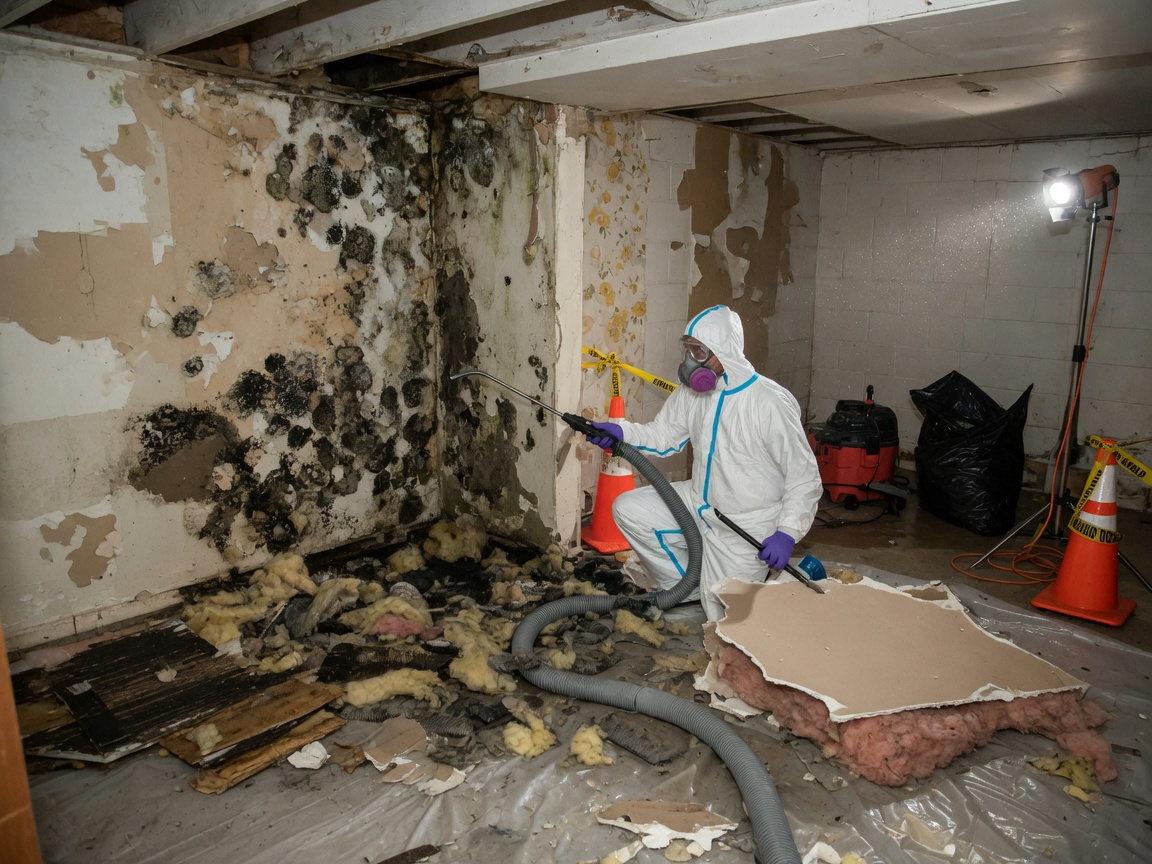
Howell’s humid subtropical climate brings hot, moist summers that push moisture into crawl spaces and attics, especially in older homes built before modern vapor barriers became common. When water intrusion occurs from roof leaks or foundation seepage near the Manasquan Reservoir watershed, mold quickly takes hold on drywall, insulation, and subflooring. Technicians must remove affected porous materials entirely rather than surface-treat them, because spores remain embedded and will reactivate during the next cold snap when indoor heating creates condensation.
Monmouth County properties in Squankum and Adelphia often feature slab-on-grade or raised-floor construction with limited access points. This layout forces careful negative-air containment to prevent cross-contamination into living spaces during removal. After extraction, industrial drying targets hidden cavities behind baseboards and in HVAC returns, because residual moisture left in wall cavities will reappear as visible growth within weeks. Homeowners frequently overlook the need to address the original water source first, which is why remediation jobs here routinely include tracing leaks back to grading issues around Howell Township Recreation fields or nearby drainage ditches.
Mold Remediation Near You — Choose Your City
Every city below has its own local Mold Remediation page with coverage details.
Edge cases include mold on engineered hardwood installed over concrete slabs, common in newer Wall and Freehold border homes. These floors trap moisture between layers and require full disassembly rather than simple sanding. Local building practices also mean many basements lack proper French drains, so remediation plans must include recommendations for improved grading and dehumidification to keep relative humidity below 55 percent year-round.
Technician insight
In Howell, the thing that catches most people out with Mold Remediation is how quickly our cold winters create condensation inside poorly insulated walls of 1970s and 1980s homes in Adelphia and Squankum. Homeowners often stop at visible spots on the drywall but leave damp insulation behind the baseboards, so the growth returns the next humid summer.
Squankum Basement After Sump Pump Failure
Water sat for several days on the concrete slab of a Squankum ranch after a sump pump quit during a summer storm. Visible black growth appeared on the lower three feet of drywall and behind the carpet pad. Crews removed the affected drywall and pad, treated the slab, and installed temporary dehumidifiers while the homeowner repaired the pump and added a vapor barrier. Clearance testing passed within five days and the space stayed dry through the following winter.
Mold Remediation Services We Offer
✓Basement Mold Remediation
Removes mold colonies from concrete walls and framing in Howell basements where seasonal groundwater and winter condensation collect.
✓Attic Mold Removal
Treats mold growth on roof sheathing and insulation caused by summer humidity and poor ventilation in Adelphia and Squankum homes.
✓Crawl Space Mold Treatment
Encapsulates and remediates mold in vented crawl spaces common to older Monmouth County properties after plumbing or storm leaks.
✓Drywall and Insulation Replacement
Cuts out and replaces water-saturated drywall and fiberglass insulation that harbor hidden mold after leaks near the Manasquan Reservoir.
✓HVAC Duct Mold Cleaning
Cleans and sanitizes ductwork that spreads spores through homes in Freehold and Wall after water damage events.
Mold Remediation Cost in New Jersey
| Service | Typical Range | What Affects It |
|---|---|---|
| Small localized area (under 10 sq ft) | $400–$900 | Limited to one wall or ceiling section; no structural replacement needed. |
| Standard basement or attic section | $1,200–$2,800 | Includes drywall removal and drying; price rises with insulation replacement. |
| Crawl space or HVAC-involved job | $2,500–$4,500 | Requires extra containment and duct cleaning; varies with access difficulty. |
| Full-room remediation after major leak | $3,800–$7,000 | Multiple surfaces and source correction; common after storms near Manasquan Reservoir. |
Ranges are typical for New Jersey and confirmed with an exact written quote before any work starts.
How it works
- 1
Moisture Mapping and Containment
Technicians use meters to locate hidden moisture in walls and floors, then set up negative-air machines to isolate the work zone from the rest of the Howell home.
- 2
Material Removal
All affected porous materials are cut out and bagged for disposal, preventing spores from becoming airborne during transport through neighborhoods like Squankum.
- 3
Antimicrobial Application and Drying
Approved treatments are applied to remaining surfaces, followed by targeted drying equipment to bring moisture levels below mold-growth thresholds.
- 4
Source Correction and Clearance
Recommendations address grading or ventilation issues, then final air sampling confirms the space meets post-remediation standards before reassembly.
Pricing
Cost depends on square footage affected and whether structural materials must be replaced; upfront quotes provided after inspection.