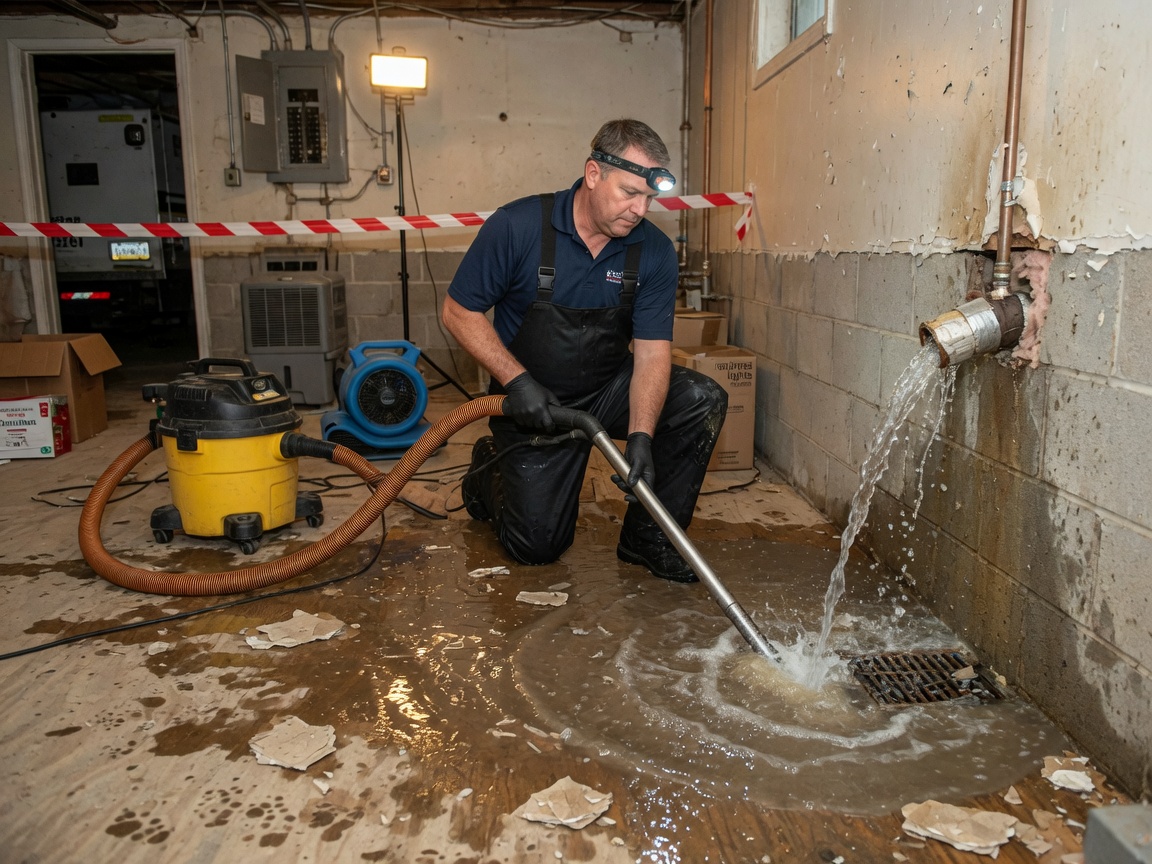
North Bergen’s older multi-family brick homes along the Hudson River see frequent burst pipes when January cold snaps hit uninsulated lines in unheated basements. Crews must thread equipment through dense blocks near James J. Braddock North Hudson County Park while contending with commuter traffic on NJ-3, US-1 and NJ-495. High local humidity after extraction raises mold risk faster than in inland towns, so dehumidification starts the same day.
Burst Pipe Water Removal in North Bergen — What We Handle
- ✓Tight row-house access and shared walls require containment barriers that suburban jobs rarely need
- ✓Proximity to the Hudson River adds moisture load that speeds secondary damage after a freeze
- ✓Winter response on NJ-495 often starts before dawn to beat New York-bound rush hour
Burst Pipe Water Removal Services We Offer in North Bergen
✓Emergency Burst Extraction
Rapid removal of standing water from floors and walls using truck-mounted pumps sized for Howell basements and crawl spaces.
✓Hidden Leak Tracing
Infrared and moisture mapping to locate water that has traveled behind walls or under subfloors in older Adelphia and Squankum homes.
✓Subfloor Drying and Sanitation
Targeted drying of plywood and joists followed by antimicrobial treatment to address water that pools near the Manasquan Reservoir water table.
✓Insulation and Vapor Barrier Removal
Safe extraction of wet fiberglass or cellulose insulation common in Monmouth County crawl spaces after pipe failures.
✓Winter Freeze Pipe Support
Temporary line isolation and heat-tape installation to prevent additional bursts during remaining cold snaps in Freehold and Wall border areas.
Howell homes built before the 1980s in Squankum and Adelphia often contain galvanized steel supply lines that corrode from the inside and split when winter temperatures drop below freezing. Once a line bursts, water travels along floor joists and into crawl spaces common on the area's gently sloping lots, saturating insulation and subflooring before homeowners notice. Technicians use moisture meters and infrared cameras to trace the full migration path rather than stopping at visible puddles.
After shutting off the main and isolating the break, crews deploy high-volume extraction wands to pull standing water from hardwood and carpet, then place air movers and dehumidifiers sized for the square footage and local humidity levels that linger after cold snaps. In homes near Manasquan Reservoir, elevated groundwater can slow drying, so technicians monitor relative humidity daily and adjust equipment placement to prevent secondary mold growth behind baseboards.
How It Works in North Bergen
- 1
On-Site Assessment
Technician arrives, locates the active leak, maps water migration through the structure, and records moisture levels in affected rooms.
- 2
Water Extraction
High-capacity pumps and wands remove standing water from floors, carpets, and low areas while protecting unaffected zones.
- 3
Drying and Monitoring
Air movers and dehumidifiers are positioned; daily moisture readings guide equipment adjustments until readings return to normal.
- 4
Final Verification
Post-drying inspection confirms all materials are dry, documentation is provided, and the space is released for repairs.
Serving All of North Bergen
We regularly handle burst pipe water removal jobs near:
- 📍James J. Braddock North Hudson County Park
- 📍Hudson River
- 📍Woodcliff
- 📍New Durham
- 📍Grantwood
Burst Pipe Water Removal Pricing in North Bergen
Costs depend on water volume, number of affected rooms, and drying duration. Upfront quotes provided after assessment.
Want the full picture of this service? See our Burst Pipe Water Removal page, or everything we do in North Bergen, NJ.