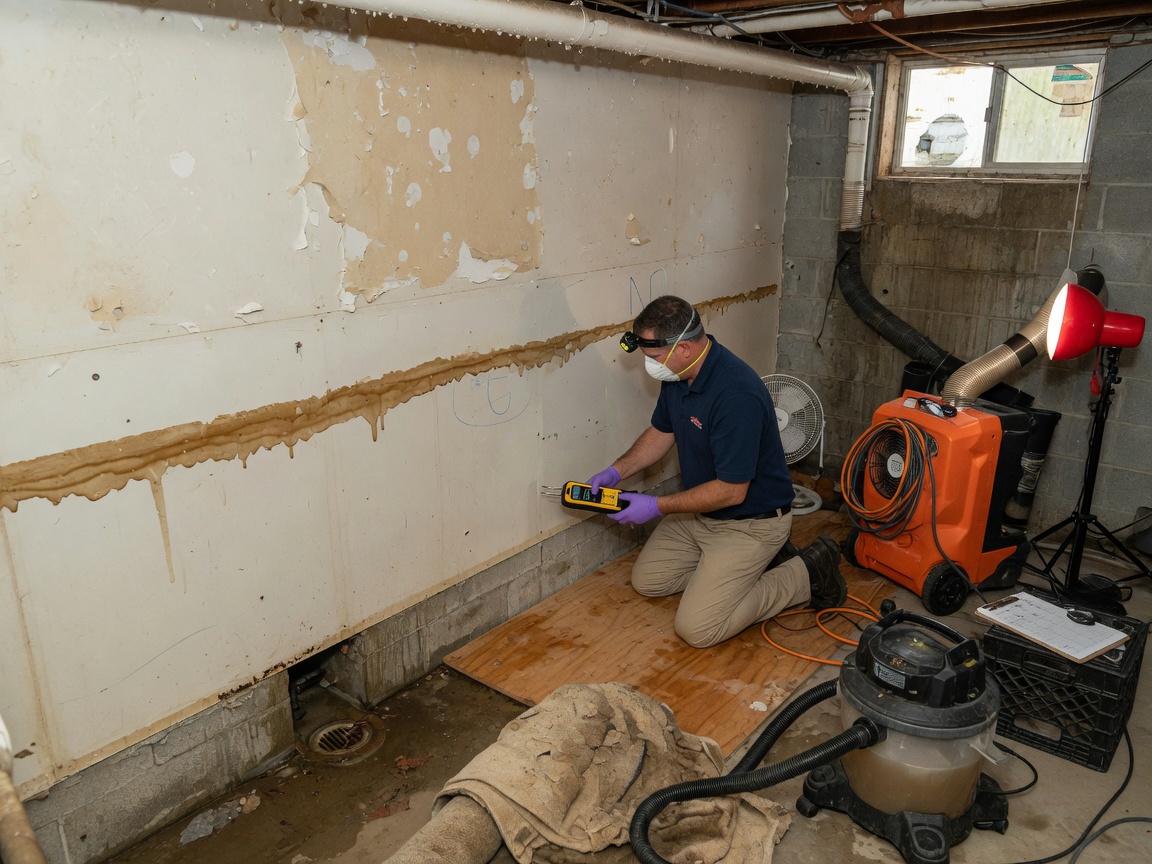
Hoboken's pre-war row homes and brownstones along the Hudson River waterfront face repeated water intrusion from storm surges that reach basements near Pier A Park and Washington Street. Winter freezes on NJ-139 and US-1 corridors often burst aging pipes inside unheated sections of buildings close to Hoboken Terminal and Stevens Institute of Technology. Crews work around dense parking and narrow access points while drying brick foundations that retain moisture longer under the area's humid subtropical summers.
Water Damage Restoration in Hoboken — What We Handle
- ✓Tight street parking and one-way routes near Maxwell's and the Hoboken Historical Museum force use of smaller extraction units.
- ✓Multi-unit buildings require coordination to stop leaks before they travel between attached homes on Washington Street.
- ✓Historic preservation rules around Pier A Park limit aggressive demolition during drying and mold remediation.
Howell sits in Monmouth County with a humid subtropical climate that brings freezing winters and heavy summer humidity. Homes in Adelphia and Squankum often date to the 1960s through 1980s with galvanized or early PVC supply lines that fail during January cold snaps. Water travels under slab foundations and into finished basements near the Manasquan Reservoir watershed, where clay-heavy soil slows natural drainage and keeps moisture trapped longer than in sandier Freehold or Wall lots.
Technicians must pull baseboards and drill weep holes in drywall to reach hidden saturation behind cabinets and under tile in these older layouts. Failure to address every pocket before the next humid stretch invites mold on lath-and-plaster or OSB subfloors common in Squankum ranches. County rules require proper disposal of contaminated carpet and insulation; skipping documentation can stall insurance claims when water crosses property lines toward Howell Township Recreation fields.
How It Works in Hoboken
- 1
On-Site Assessment
Technician maps moisture with meters, identifies affected materials, and notes any shared-wall risks in attached homes.
- 2
Water Removal
Pumps and wands extract standing water while protecting adjacent rooms in dense Squankum layouts.
- 3
Drying And Monitoring
Equipment runs until meter readings match unaffected areas, with daily checks during humid periods.
- 4
Material Replacement
Remove and replace damaged drywall, flooring, and insulation per local disposal rules.
- 5
Final Verification
Post-dry inspection confirms no residual moisture before homeowner return.
Water Damage Restoration Services We Offer in Hoboken
✓Emergency Water Extraction
Rapid removal of standing water from basements and crawl spaces in Squankum and Adelphia homes using truck-mounted pumps sized for Monmouth County clay soils.
✓Structural Drying and Dehumidification
Placement of air movers and desiccants to pull hidden moisture from walls and subfloors before summer humidity triggers mold in older Howell housing stock.
✓Basement Flood Cleanup
Full removal of saturated insulation, drywall, and flooring plus antimicrobial treatment for properties near the Manasquan Reservoir watershed.
✓Pipe Burst Restoration
Targeted drying and material replacement after winter freezes split lines in 1970s Adelphia and Squankum ranches with slab plumbing.
✓Sewage Backup Remediation
Safe extraction and disposal of contaminated water from municipal or septic overflows common after heavy rains in low-lying Howell neighborhoods.
Serving All of Hoboken
We regularly handle water damage restoration jobs near:
- 📍Hoboken Terminal
- 📍Stevens Institute of Technology
- 📍Pier A Park
- 📍Washington Street
- 📍Hoboken Historical Museum
Water Damage Restoration Pricing in Hoboken
Upfront quotes given on site after inspection; final cost depends on water volume, affected square footage, and whether hidden wall or subfloor drying is required.
Want the full picture of this service? See our Water Damage Restoration page, or everything we do in Hoboken, NJ.